• Skip to main content
  • Skip to primary sidebar

NC Planning

Providing Proactive and Invaluable Legal Planning

Schedule Consultation

919.900.4720

  • About Us
    • Our Mission
    • Meet Our Team
  • For Businesses
    • Business Law
      • Asset Protection
      • Business Start-Ups
      • Contracts
    • Business & Corporate Planning
    • Commercial Real Estate
    • Mergers & Acquisitions
    • Professional Practice Planning
      • For Dental Practices
      • For Healthcare Practices
      • For Veterinary Practices
      • For Law Firms
    • Succession Planning
    • Tax Planning
    • Trademark Licensing
  • For Individuals
    • Comprehensive Estate Planning
      • Trusts
      • Wills
      • Power of Attorney
      • Revocable Trusts
      • Estate Planning For Minor Children
    • Estate & Trust Administration
    • High-Net-Worth Estate Planning and Administration
    • Charitable Planning
    • Special Needs Planning
    • Elder Law
  • Resources
    • Testimonials
    • FAQs
    • Events
      • Past Webinars
    • Newsletter
    • Online Forms
    • Videos
    • Webinars on Demand
    • Our Blog
    • Common Legal Terms
    • Make a Payment
  • Contact
    • Schedule A Consultation
  • Areas We Serve
    • Asheville, NC
      • Asheville, NC Estate Planning Lawyers
      • Asheville, NC Trust Lawyers
      • Asheville, NC Will Lawyers
    • Black Mountain, NC
      • Black Mountain, NC Estate Planning Lawyers
      • Black Mountain, NC Trust Lawyers
      • Black Mountain, NC Will Lawyers
    • Cary, NC
      • Cary, NC Business Plan Formation Lawyers
      • Cary, NC Estate Planning Lawyers
      • Cary, NC Trust Lawyers
      • Cary, NC Wills Lawyers
    • Raleigh, NC
      • Raleigh, NC Business Plan Formation Lawyers
      • Raleigh, NC Estate Planning Lawyers
      • Raleigh, NC Trust Lawyers
      • Raleigh, NC Wills Lawyers
    • Wilmington, NC
      • Wilmington, NC Estate Planning Lawyers
      • Wilmington, NC Trust Lawyers
      • Wilmington, NC Business Plan Formation Lawyers
      • Wilmington, NC Will Lawyers
    • Greensboro, NC
      • Greensboro, NC Business Plan Formation Lawyers
      • Greensboro, NC Estate Planning Lawyers
      • Greensboro, NC Trust Lawyers
      • Greensboro, NC Will Lawyers
    • Charlotte, NC
      • Charlotte, NC Business Plan Formation Lawyers
      • Charlotte, NC Estate Planning Lawyers
      • Charlotte, NC Trust Lawyers
      • Charlotte, NC Will Lawyers
    • Durham, NC
      • Durham, NC Business Plan Formation Lawyers
      • Durham, NC Estate Planning Lawyers
      • Durham, NC Trust Lawyers
      • Durham, NC Will Lawyers
    • Mecklenburg County, NC
      • Mecklenburg, NC Business Plan Formation Lawyers
      • Mecklenburg County, NC Estate Planning Lawyers
      • Mecklenburg County, NC Trust Lawyers
      • Mecklenburg, NC Will Lawyers
    • Orange County, NC
      • Orange County, NC Estate Planning Lawyers
      • Orange County, NC Will Lawyers
    • Union County, NC
      • Union County, NC Estate Planning Lawyers
      • Union County, NC Trust Lawyers
      • Union County, NC Business Plan Formation Lawyers
      • Union County, NC Will Lawyers
    • Wake County, NC
      • Wake County, NC Estate Planning Lawyers
      • Wake County, NC Will Lawyers
    • Woodfin, NC
      • Woodfin, NC Estate Planning Lawyers
      • Woodfin, NC Will Lawyers

Google Reviews Link

+175

Home » FAQs » What Are the Different Types of Corporations, and Which Should I Choose for My Company?

What Are the Different Types of Corporations, and Which Should I Choose for My Company?

May 31st, 2022 in FAQs Categories: Business Planning, Business Startups, and Business Tax Planning

Types of Corporations

Opening a new business is an exciting endeavor and an important step for any entrepreneur. Whether you decided to resign from an unfulfilling job to chase your dreams or you are an experienced business owner looking to expand your portfolio, the first step in this journey is to select the most appropriate type of business structure – and there are quite a few to choose from. One of your questions will be “Which Types of Corporations Should I Choose for My Company”? Our business start-up law firm has helped many business owners with this issue and offers a quick overview and important insights to help you decide which business structure type is right for you.

How Does the Type of Business Structure Affect How My Business Operates?

There are two very important considerations to make when choosing the type of business structure you want for your new business: legal implications and tax considerations. When it comes to legal implications, running a business always comes with a degree of inherent risk. Even the best-prepared business owners may end up facing a lawsuit (such as a personal injury suit or a discrimination lawsuit). The right type of corporation or business structure can help limit a business owner’s personal liability in the event of a legal battle.

Second, there is the issue of how the business will pay taxes. Some corporation types exist as separate legal entities and thus are required to file their own tax returns and pay their own taxes. Other business entities can be included in the owner’s personal tax returns and do not require separate tax payments. These are just a few of several considerations you need to make when choosing your business structure type.

What Are the Differences Between an S Corp and a C Corp?

According to the Small Business Administration, a C Corp is a legal entity that exists separately from its owners and can “make a profit, be taxed, and can be held legally liable.” C Corps offer the strongest protection in terms of personal liability (the owner’s personal assets are not at risk in case of a civil lawsuit because a C corp is an entity on its own), but this enhanced liability protection comes at a cost. The initial investment to form a C corp is considerable, and owners are required to maintain accurate records, reports, and operational procedures. A C Corp can sell stocks as a way of raising money and is best suited for business owners who plan to sell their business in the future or who intend to become a publicly traded and owned entity.
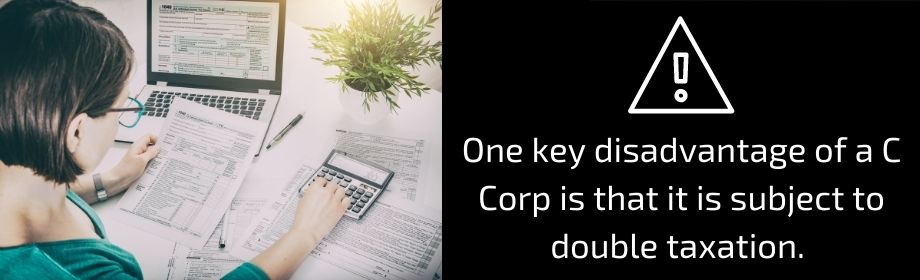
One key disadvantage of a C Corp is that it is subject to double taxation. It is required to pay income taxes on its profits, and those profits are taxed once again when passed on to the corporation’s shareholders. The shareholders may not claim any losses or take any deductions on the expenses of the C Corp for their own personal tax returns. To solve this problem, some entities may be eligible to become an S Corp – a business entity that passes on most of its finances to its shareholders, including tax deductions and credits. In practical terms, an S Corp is taxed as a partnership and thus avoids the double taxation that a C Corp is subject to. S Corps are limited to having a maximum of 100 shareholders, while C Corps can have unlimited shareholders.

Is Having an LLC or a Partnership Better Than a Sole Proprietorship?

For those running a high-risk business with more complex operations and with significant growth plans, S Corps and C Corps are feasible choices. But not everyone is willing or able to handle the requirements and costs that come with those options. If two or more people wish to form a business together, they can choose to form a partnership. Partnerships are required to file an annual information return reporting any profits, losses, and deductions, but each partner is responsible for declaring profits and losses in their own tax return and paying its share of income taxes. All partners are responsible for any debts or losses incurred by the partnership.

In order to form an LLC, business owners need to file formal articles of organization with their state. Owners in an LLC pay self-employment taxes on any LLC profits and can use their personal tax return to declare profits and losses. Unlike in a partnership, members of an LLC are not personally liable for any debts or losses incurred by the business.

Last, there is the option of a sole proprietorship, which requires no formal filing. While this option is the easiest one for a new business owner, it is not recommended for high-risk businesses as it offers no protection in terms of personal liability in case of a lawsuit or bankruptcy. Partnerships and Sole Proprietorships are not considered corporation types and offer little in terms of asset protection, but are a less costly way to form a business or to test out a business idea before transforming it into a corporation.

What Other Corporation Types Are There and How Do I Choose the Best One?

Which type of corporation should I choose for my company will be a top question when you’re looking into this transfer. There are other types of corporations available for those looking to build a non-profit organization, a cooperative, a B Corp, or a Close Corporation. As you can see, there are many options and it may be hard to choose the right structure for your business. That is why the attorneys at NC Planning offer a free strategy session by phone to anyone who has questions about starting their business. Contact us to learn your options.
Primary Sidebar

Get Started Today!

  • This field is for validation purposes and should be left unchanged.
  • By checking this box, I consent to receive transactional SMS messages and phone calls from NC Planning related to my inquiry, webinar registration, appointment, or other services I have requested. These communications may include registration confirmations, webinar reminders, appointment reminders, event updates, access information, and follow-up resources. Please note, users may receive follow-up communications from a member of our team and/or an AI assistant. Message frequency may vary. Message and data rates may apply. Reply HELP for assistance or STOP to opt out at any time. SMS consent is not required to register for the webinar or receive legal services. Privacy Policy & Terms.
  • This field is hidden when viewing the form

Testimonials

Felt as though my needs were handled in a most professional manner. Their team was courteous, friendly, and helpful all along the way. I would especially like to commend Michelle for her terrific guidance throughout the process. NC Planning is truly the go-to group for your professional legal nee...
Read All Testimonials

Business Planning

  • Professional Practice Planning
  • Business Planning for Dentists
  • Business Planning for Healthcare
  • Business Planning for Veterinary Practices
  • Business Planning for Law Firms
  • Business Law
  • Mergers & Acquisitions
  • Asset Protection
  • Start-Ups and Formation
  • Business Contracts
  • Succession Planning
  • Tax Planning
  • Trademark Licensing

Personal Planning

  • Comprehensive Estate Planning
  • Trusts
  • Revocable Trusts
  • Wills
  • Power of Attorney
  • Estate Planning for Minor Children
  • Estate Administration
  • Charitable Planning
  • Special Needs Planning
  • Medicaid Planning
  • Elder Law
  • High-Net-Worth Estate Planning

5000 Centregreen Way, Suite 500
Cary, NC 27513

(919) 900‑4720 clientservices@ncplanning.com

4801 Glenwood Ave Suite 200-10
Raleigh, NC 27612

(919) 568-3681 clientservices@ncplanning.com

806 Green Valley Road, Suite 200
Greensboro, NC 27408

(336) 932-8355 clientservices@ncplanning.com

1209 Culbreth Dr., #211
Wilmington, NC 28405

(919) 887-7341 clientservices@ncplanning.com

Connect With Us

Copyright © 2026 NC Planning
Disclaimer Privacy Policy


Mailing Address
127 W Hargett St, Ste 301, PMB 190 Raleigh, NC 27601

  • About Us
    • Our Mission
    • Meet Our Team
  • For Businesses
    • Business Law
      • Asset Protection
      • Business Start-Ups
      • Contracts
    • Business & Corporate Planning
    • Commercial Real Estate
    • Mergers & Acquisitions
    • Professional Practice Planning
      • For Dental Practices
      • For Healthcare Practices
      • For Veterinary Practices
      • For Law Firms
    • Succession Planning
    • Tax Planning
    • Trademark Licensing
  • For Individuals
    • Comprehensive Estate Planning
      • Trusts
      • Wills
      • Power of Attorney
      • Revocable Trusts
      • Estate Planning For Minor Children
    • Estate & Trust Administration
    • High-Net-Worth Estate Planning and Administration
    • Charitable Planning
    • Special Needs Planning
    • Elder Law
  • Resources
    • Testimonials
    • FAQs
    • Events
      • Past Webinars
    • Newsletter
    • Online Forms
    • Videos
    • Webinars on Demand
    • Our Blog
    • Common Legal Terms
    • Make a Payment
  • Contact
    • Schedule A Consultation
  • Areas We Serve
    • Asheville, NC
      • Asheville, NC Estate Planning Lawyers
      • Asheville, NC Trust Lawyers
      • Asheville, NC Will Lawyers
    • Black Mountain, NC
      • Black Mountain, NC Estate Planning Lawyers
      • Black Mountain, NC Trust Lawyers
      • Black Mountain, NC Will Lawyers
    • Cary, NC
      • Cary, NC Business Plan Formation Lawyers
      • Cary, NC Estate Planning Lawyers
      • Cary, NC Trust Lawyers
      • Cary, NC Wills Lawyers
    • Raleigh, NC
      • Raleigh, NC Business Plan Formation Lawyers
      • Raleigh, NC Estate Planning Lawyers
      • Raleigh, NC Trust Lawyers
      • Raleigh, NC Wills Lawyers
    • Wilmington, NC
      • Wilmington, NC Estate Planning Lawyers
      • Wilmington, NC Trust Lawyers
      • Wilmington, NC Business Plan Formation Lawyers
      • Wilmington, NC Will Lawyers
    • Greensboro, NC
      • Greensboro, NC Business Plan Formation Lawyers
      • Greensboro, NC Estate Planning Lawyers
      • Greensboro, NC Trust Lawyers
      • Greensboro, NC Will Lawyers
    • Charlotte, NC
      • Charlotte, NC Business Plan Formation Lawyers
      • Charlotte, NC Estate Planning Lawyers
      • Charlotte, NC Trust Lawyers
      • Charlotte, NC Will Lawyers
    • Durham, NC
      • Durham, NC Business Plan Formation Lawyers
      • Durham, NC Estate Planning Lawyers
      • Durham, NC Trust Lawyers
      • Durham, NC Will Lawyers
    • Mecklenburg County, NC
      • Mecklenburg, NC Business Plan Formation Lawyers
      • Mecklenburg County, NC Estate Planning Lawyers
      • Mecklenburg County, NC Trust Lawyers
      • Mecklenburg, NC Will Lawyers
    • Orange County, NC
      • Orange County, NC Estate Planning Lawyers
      • Orange County, NC Will Lawyers
    • Union County, NC
      • Union County, NC Estate Planning Lawyers
      • Union County, NC Trust Lawyers
      • Union County, NC Business Plan Formation Lawyers
      • Union County, NC Will Lawyers
    • Wake County, NC
      • Wake County, NC Estate Planning Lawyers
      • Wake County, NC Will Lawyers
    • Woodfin, NC
      • Woodfin, NC Estate Planning Lawyers
      • Woodfin, NC Will Lawyers